
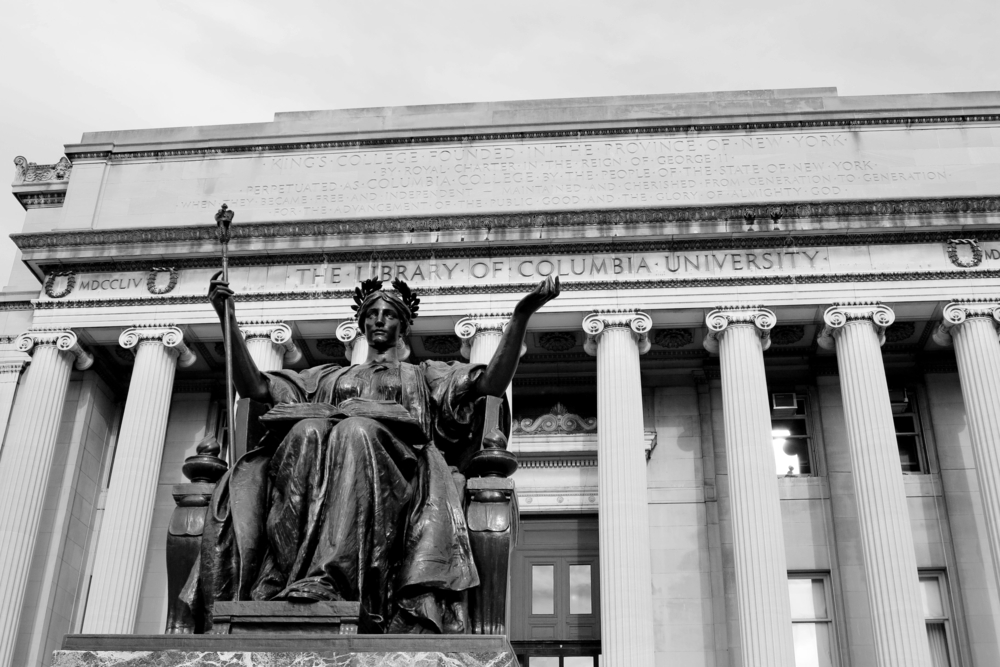
May 2, 2024: American college campuses are on fire with protests over the Israeli-Hamas conflict. Just like what one might find on TikTok, the protests are largely focused against Israel “oppression” of Palestinians and a show of support for the Palestinian cause. Aside from disrupting college campus life, there have been allegations of threats of violence against Jewish students and anti-Semitic, anti-Israel chants from some protestors. The protests seemed to have been initiated at elite universities like Columbia University in New York City and spread to other campuses. Since students seemed to be distracted from their regular studies, and since we can’t resist irony, TALUS has decided to try and educate our “Best and Brightest” about American life and moreover, give a lesson in Law & Order.
“Admissions”: Season 9, Episode 22 from Law & Order
The core of today’s lesson is exemplified by this episode from one of America’s classic television shows. Let me give a summary:
“The murder of a young female student named Sarah Kincaid occurs on the campus of Hudson University (which coincidentally seems to be the fictionalized version of Columbia University). The police investigation ultimately leads them to their primary suspect, Kincaid’s classmate Dennis Michaels. Michaels’ friend Peter Kelly gives him an alibi, though the truth is that Kelly was present when Michaels killed Sarah. Michaels helped Kelly cheat to pass his classes, so Kelly feels obligated to cover for him. Prosecutor Jack McCoy pressures Kelly to reveal the truth and eventually gets Kelly’s wealthy father to assist. The father proceeds to lay down the law with his son, compelling him to cooperate in implicating Michaels.”
The scene that sticks in my brain from this show is when the wealthy father comes to the District Attorney’s office and tells the son (Kelly) to stop protecting the killer to prevent himself (the son) from getting into trouble. The father used words to the effect, “This is how things happen in the real world . . . I suggest you step into it.” As a parent myself, this sort of reality-based guidance I give to my children has led me to be called the “dream crusher” at home. But for them, and for the anti-Israeli “Best and Brightest” protestors at elite universities, it is a lesson that needs to be learned.
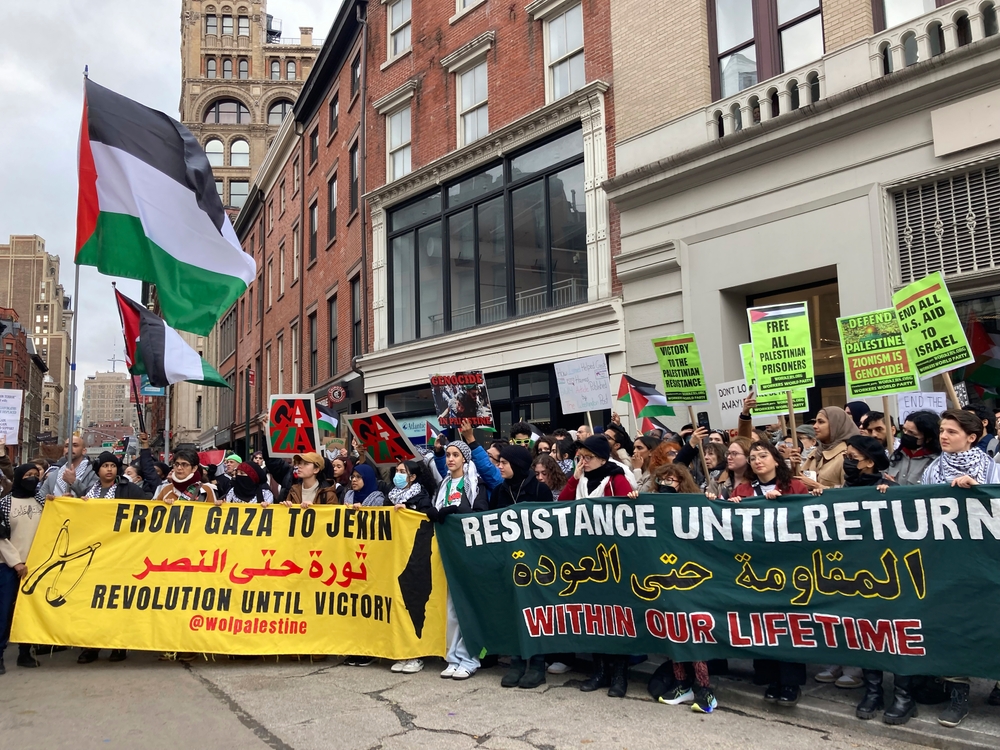
Palestinian supporters in New York City
Can we have an American Protests without the Hating on America?
The right to peaceably gather to protest is a hallmark of American democracy. Certainly, some self-criticism and debate can be helpful to the country getting things right, or at least moving in a better direction. While we need to learn the mistakes of history so we do not repeat them, it is somewhat of an overstatement that America is a primary source of evildoing in the world.
Turning to the plight of Palestinians in Gaza, the Israeli response has dragged on for months. Considering the toll on Palestinians in Gaza, the case for protesting US support of Israel seems to make some sense. However, student condemnation and protests against Israel and US support of Israel started immediately after Hamas attacked Israeli civilians on October 7. It should not have come as a surprise to well-educated students that America would pledge its support to its longtime ally in the region, a lonely beacon of democracy and capitalism in the Middle East. This is especially true considering the horrific nature of Hamas’ civilian attacks including a massacre of many college-aged Israelis at a concert. Nevertheless, even before Israel had mounted any sort of military response, protests in America had started and college students seemed poised to voice their disapproval of Israel’s treatment of Palestinians. At Harvard, dozens of student groups signed onto a letter from the Harvard Palestine Solidarity Committee (PSC) on Oct. 7 — the day Hamas launched its surprise attack on Israel — holding Israel “entirely responsible for all unfolding violence.” The president of New York University’s Student Bar Association wrote that “Israel bears full responsibility for this tremendous loss of life,” in a letter to the group that quickly went viral and drew widespread condemnation.
True to our They’re All Lying to Us name, we of course need to point out that there is further evidence that misinformation and disinformation played a role in shaping and increasing the immediate outrage against Israel in the days after October 7. We also wonder if the contributions to universities from Arab countries such as Qatar might be influencing professors and programs. Disinformation, misinformation, and other forms of influence seem to find fertile ground in young, progressive university students, a group ready to embrace a cause fitting the “woke-style” principle which characterizes America and its allies as “oppressors of the oppressed.”
The Irony of Elite University Students Hating on America
Point 1: America benefits overall from its global policies and the greatest benefits accrue to the elites.
A professor from Harvard points out that America’s role in a more integrated global economy combined with technology have created new industries and opportunities, mainly benefiting those with the capital and education to leverage these changes.
“As a result, wealth has become increasingly concentrated in the United States. Today the richest 20 percent of American households owns 77 percent of the country’s wealth—more than three times that owned by the entire middle class (the middle 60 percent of households). Even more striking, the richest one percent of American households owns substantially more than the middle class combined.”
And you can bet that bachelor’s degree graduates of Columbia, many of whom make $100,000 per year within a few years of graduation, are likely benefactors.
Point 2: Protesting students at Columbia and similar institutions are (or are on the pathway to becoming) elites.
Supporting the theory that graduates of elite universities occupy a privileged position in America, New York Times journalist David Brooks wrote a thought-provoking article last year. At its core, the article questioned whether the durability of support for Donald Trump might in part be caused by the systems elites have implemented. Brooks wrote:
“Members of our class are always publicly speaking out for the marginalized, but somehow we always end up building systems that serve ourselves. The most important of those systems is the modern meritocracy. We built an entire social order that sorts and excludes people on the basis of the quality that we possess most: academic achievement.”
Brooks goes on to describe how journalism has become more elitist: “more than 50 percent of the staff writers at the beloved New York Times and The Wall Street Journal attended one of the 29 most elite universities in the nation.”
Point 3: Maybe the conclusion is that many protesting students at elite universities dislike the United States because they see it as an “oppressor”.
Pulling back to the 30,000 foot view, here is how one conservative outlet framed the university protests in November:
“Americans are finally catching on that the oppressor-oppressed narrative being taught in our schools and universities is not a conspiracy theory disseminated by conservatives. It’s real. Jewish students having to barricade themselves in a college to escape a mob in Manhattan, of all places, has opened people’s eyes to the threat woke ideology represents to civilization.”
A New York Times writer used the writings of economist Arnold Kling to describe the difference between progressive and conservative perspectives:
“Progressives, Kling wrote, see the world as a struggle between the oppressor and the oppressed, and they try to help the oppressed. Conservatives see the world as a struggle between civilization and barbarism — between order and chaos — and they try to protect civilization.”
While I may be dumb and perhaps much dumber compared to the Best and Brightest at elite American universities, it seems that the anti-Israeli protestors may commonly fit within a group of Progressives which, more broadly, dislikes America as an oppressor. The nature of some of the American Progressives’ protests, including some items labeled “woke”, absolutely lead conservatives to believe the left “hates America”. And sometimes, it makes moderates feel the same way. It seems over the top to hate on Columbus, blame America’s southern border immigration problems on believed abuse of our Central and South American neighbors, and otherwise paint the universe as damaged primarily as a result of America acting as the “oppressor of the oppressed.” When it comes to the current Gaza protests, commentators have suggested these students are not well educated when it comes to Israeli-Palestinian affairs. Combine that with the speed at which the on-campus conversation went against Israel even on October 7, one can easily conclude that this dislike for America is built in.

Time for Protestors to Step into the Real World
Ultimately, it seems that the student protestors have been ineffective at swaying broader public opinion to meet their goals. As one writer put it:
“Effective protests always connect means and ends. What makes the current round of protests so confusing is the incoherence of the protesters’ goals. What is the point of large encampments, blocking access to buildings and shouting hateful slogans?”
Student protestors do not even have support from left leaning media outlets like MSNBC. It seems that every talking head on Morning Joe speaks out against their protests. I would have thought that intelligent youth would be winning on social media and perhaps swaying public opinion. However, student protestors seem to be flunking on social media as well. They only seem able to use youth-dominated social media channels like Sidechat or TikTok to impress their friends. While they did go “old school” with campus protests, student protestors didn’t seem to notice from their political science studies that the median age of the House of Representatives is 58 and the US Senate is 65. Nor did they take into account the major party Presidential candidates are 81 and 77 years old. This generation of leadership isn’t on Sidechat or TikTok – they’re much more likely to be on Facebook – one can learn this simple fact in a digital media course. Plus, the older generation that makes up Congress and more mature voters are more likely to be “law and order” types than oppressor-oppressed disciples. I would have thought that students might have learned that in a sociology or psychology class, or a history class which covered the Presidential election of 1968. And just as in 1968 when student Vietnam protests seemed to help get “law and order” candidate Richard Nixon elected, many sources are indicating that student protests may well lead to anti-Progressive candidate Donald Trump winning in November.
In assessing the campus protestors, one analyst concluded:
“Protesters like to claim that they are “speaking truth to power.” That is both noble and heroic. It is also rare because speaking the truth requires knowing the truth. And knowledge is not acquired by joining the crowd in chanting slogans, but by taking the time to talk and listen, ask questions, debate, read and think. It is a slow, arduous and ultimately rewarding process. That’s called education.”
My conclusion? I may have a far inferior education to the university protestors, but I have a lot of life experience, including watching Law & Order. And just as elite university student Peter Kelly was told by his father in the “Admissions” episode, I say to the college protestors: “Its time to step into the real world.”