

April 2024. It wouldn’t seem to be controversial to say that unions more traditionally support Democrats. Yet, in a curious twist of political fate, Republicans have been making significant inroads with the working-class electorate. In fact, recent polling shows Biden and Trump were tied at 47% among union members in six key battleground states when asked who they’d vote for in 2024. They’re All Lying to Us wonders, “what is behind this?” How is it that union workers have abandoned Democrats? Is it because of misinformation and disinformation spread via media and social media? Or was it Democrats who abandoned union workers? Let’s do a level set on unions and lower wage workers to see what truths we can pull from this mystery. By the way, the title of this article is drawn from the 1996 Arnold Schwarzenegger movie, Eraser in which Joe Viterelli (pictured above) played an intimidating union boss.
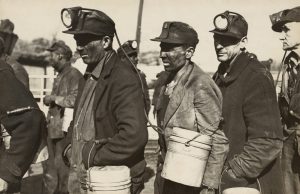
Alabama coal miners unionized in 1934
The Evolution of Unions
Unions have played a significant role in shaping the labor market. They have been instrumental in advocating for workers’ rights, negotiating better pay, and improving working conditions. However, the influence of unions has seen a substantial decline over the past 40+ years. The decline of unions since the 1980s was spurred by a combination of economic and political developments. The opening up of overseas markets increased competition in many highly organized industries. Outsourcing emerged as a popular practice among employers seeking to compete in a radically changed environment. Simultaneously, US employers developed practices that proved effective at ridding establishments of existing unions and preventing nonunion workers from organizing.
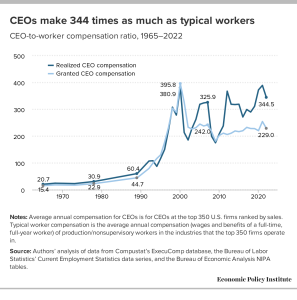
Union membership in the United States has decreased from 29% in 1970, to 20% in 1980, to 10% in 2022. However, the past few years has seen a resurgence in union activities. Among the unions that have achieved major victories: the United Auto Workers (UAW), UPS Teamsters, and writers and actors in Hollywood. As unions have declined in influence, the wealth and income gap between rich and poor has widened. A major study by academic economists found that about 10 percent of the increase in American inequality since 1968 was a result of falling union membership. And the CEOs and executives of larger corporations commonly make 100, 200, or even 300+ times their average workers.
Benefits and Negatives of Unions
Unions have been associated with several benefits. They promote higher wages, with unionized workers earning significantly more than their non-union counterparts. They also help workers secure better benefits, with over 90% of unionized workers entitled to medical benefits compared to about 70% of non-union workers. Furthermore, unions provide worker protections, ensuring that employees can only be fired for a “just cause”.
However, unions also have their downsides. Critics argue that union contracts make it difficult for companies to fire unproductive employees and increase long-term costs, decreasing competitiveness. Additionally, unions can disincentivize exceptional individuals and create market distortions that lead to job losses.
Democratic Support for Unions
The Democratic Party has historically been a strong supporter of labor unions. The party’s platform states, “when workers are strong, America is strong. Democrats will make it easier for workers, public and private, to exercise their right to organize and join unions”. Democrats also believe that labor unions helped build America’s middle class, and organized labor remains critical to fulfilling America’s basic bargain: If you work hard and do your part, you should be able to get ahead and stay ahead. More than eight-in-ten liberal Democrats (83%) say unions have a positive effect on the way things are going in the U.S.
Republican Historical Opposition to Unions
On the other hand, the Republican Party has historically been a consistent opponent of labor unions. Since the New Deal, Republicans have consistently supported efforts to weaken unions by eliminating or eroding statutory protections for the right to organize and collectively bargain for better wages, benefits, and working conditions. In the decades since Ronald Reagan’s presidency, GOP lawmakers championed “right to work” laws designed to limit union membership. In 2021, congressional Republicans overwhelmingly voted against a bill that would make it easier for workers to form unions.
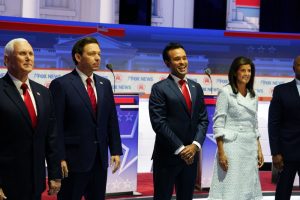
2024 GOP Presidential Debate Candidates
Current Republican Leadership Opposition to Unions and Pro-Worker Provisions
GOP-led states and legislative efforts often stand in contrast to what might be termed “worker-friendly” policies. Notably, many Republican states have enacted “Right to Work” laws, perhaps more aptly named “Right to be a Free Loader” as such laws allow individual employees at a union shop to “opt out” of paying union dues, but still receive the benefits of the union’s bargained for benefits! This prohibition against mandatory dues undermines the financial condition and bargaining power of unions.
Beyond unions, Republicans commonly fight against other pro-worker legislation such as minimum wage increases. They uniformly opposed a Democrat-led effort in 2021 to raise the national minimum wage from $7.25 and hour to $15 (though more recently some Republicans are supporting an $11/hour minimum wage, basically the 2024 indexed equivalent to $7.25 when it was passed in 2009.) Republican 2024 Presidential candidates commonly support right to work laws, oppose unions (Nikki Haley calls herself a “union buster”), and Donald Trump encouraged union members to not pay their dues and did not act on a 2016 campaign promise to raise the minimum wage to $10/hour. Last Fall, Senator Tim Scott suggested that the striking autoworkers ought to be fired. Florida’s Governor, Ron DeSantis, also seems to be anti-union and against pro-worker legislation:
- In 2020, he opposed a ballot initiative to gradually raise Florida’s minimum wage to $15 an hour, which voters ultimately approved.
- While in Congress, he sponsored a national Right to Work (aka “Right to be a Free Loader”, see above) bill and also voted to reduce the National Labor Relations Board’s funding and opposed “prevailing wage” requirements for construction workers employed by government contractors.
- He signed a Florida bill last May that restricted unions for teachers and other public-sector employees by banning automatic dues deductions from paychecks and letting employees leave a union at any time, among other things. Notably, unions that tend to support Republicans — including those for police officers, firefighters and correctional officers — were largely exempted from the new restrictions!!
So Why Do Many Union Workers Not Support Democrats?
Let’s suppose you are a UAW worker. After a short strike last Fall, the highest paid union workers received an immediate pay increase of 11% and will receive a total pay increase of 25% over the course of the 4½-year deal. The two-tiered pay system that created great wage disparity for workers with less seniority was largely corrected meaning that the lowest paid workers received increases of up to 160 percent! The new deal also included cost-of-living protections, increased 401(k) contributions, more paid time off, and secured the re-opening of a Stellantis plant in Illinois. The question for a UAW member: In light of the anti-union actions of leading Republicans noted above, why would you support them? Let me suggest a few reasons:
- Maybe they have other reasons outside of their employment to support Republicans.
- It could be that they possess the great American trait of fierce independence. Being compelled to join a union just doesn’t “feel right”. And the thought of workers joining together in a union smells socialist.
- Perhaps they believe that unions create a distortion of the free-market economy and may reduce broader economic growth that would, in turn, allow for more employment opportunities for them.
- Policy positions which indirectly impact employment opportunities might be at play. Memories of NAFTA (signed by Bill Clinton, but largely negotiated by George Bush and supported by both parties) and the “sucking sound” of jobs going to Mexico (according to 1992 and 1996 Presidential candidate Ross Perot) might push union members to support Republicans.
- Democratic weakness on immigration controls might create more competition for jobs and reduce American wages. This might explain why Republican support is high among building trades unions.
- Current economic conditions might make things difficult for many workers: inflation on core items like food and housing under the Biden Administration and Democratic tone deafness saying, “the economy is great”, might lead one to give the Republicans a try.
- Republicans are better at messaging (that might sometimes be factually or logically challenged), finding a way to anger working class people by harping on immigration, globalism, electric cars and climate initiatives ruining American jobs, and elitism associated with raising the minimum wage for fast food workers to $20/hour in California.
- And the “protest vote” against Democrats might also have support from the far left. Progressive union members might believe the unions did not go far enough. They might further believe that Democrats are just part of the corporate machine that runs America. After all, Democrats undermined left-wing champion Bernie Sanders in 2016.
Since this is the “They’re All Lying to Us” blog and podcast, I can’t help but feeling that communications from the media and social media have something to do with what seems to be an incongruent possibility: many union workers support Republican candidates who commonly act against unions and certain American workers. Yet, unlike the liberal elite media, I can understand the feeling that the Democrats have let unions down — maybe not directly on union legislation or in running the Department of Labor, but in many other ways which impact union member lives. In our binary political system, neither side seems to be a good fit for many of us. After years of holding your nose and voting for the lesser of two evils, both of which may have been misleading you along the way, many may be ready to blow the system up.
Rather Than Blowing the System Up, Let’s Try a Bit More Support for Workers!
I grew up in a union family firmly dedicated to voting for the Democrats largely due to union membership. While I have grown more skeptical of the Democrats as they have drifted a bit, I still believe that unions can be a force for good, good for workers and good for America. We have spent the past 40 years reducing unions. Over that time, “trickle down economics” has seemingly only made the rich richer while straining the budgets of many workers. A married couple with two children who work full-time at $10/hour struggle to get by and may still qualify for public assistance such as food stamps. We’ve tried the anti-union, anti-worker method and hoped that the rising economic tide would lift all boats. That seems to have failed. I support trying something different and seeking to re-build unions might be the best tool to balance the playing field.
While I do not support the full Bernie Sanders socialist vision, I do oppose the Republican anti-union and anti-worker legislation position. In our binary choice universe, this item alone does not make me content voting for the Democrat. It instead leaves me perpetually frustrated with voting for a compromise. And while we wait for bigger systemic changes, perhaps including a real third-party option, I would encourage all workers to press both party’s candidates to support unions and other worker rights, and ultimately the policies that bring back the vibrancy of America’s middle class.