
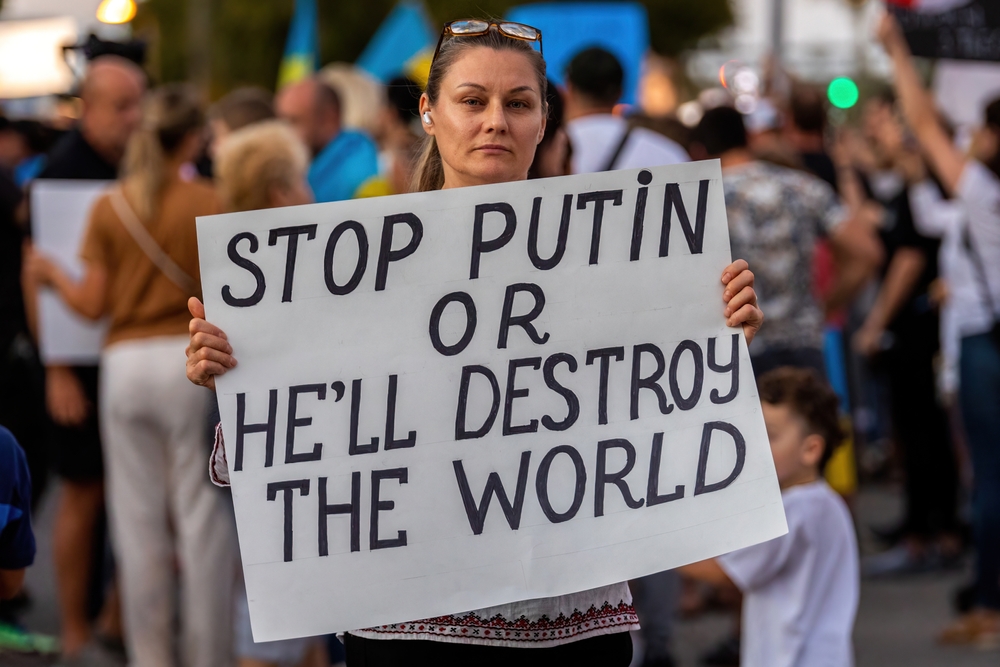
After months of legislative delays, the U.S. House of Representatives finally passed a bill that will provide additional funding to aid Ukraine in its ongoing struggle against Russian aggression. This decision underscores a united Western commitment to uphold democratic values against authoritarian overreach, marking another chapter in America’s long-standing foreign policy tradition of supporting democracies worldwide. They’re All Lying to Us (TALUS) wonders: What the hell took so long? The U.S. Senate supported more Ukraine funding by a 70-29 vote months ago. Could it be Russian disinformation was at play?
The Current State of the War
Russia invaded Ukraine in February 2022. Reports indicate that the Russian government and its propaganda outlets have openly announced a goal of taking Ukrainian territory and subjugating its government to the Kremlin. As for the battle on the ground, Ukraine has recaptured 54 percent of occupied territory that was taken early in the war, while Russia still occupies 18 percent of the country. However, Ukraine’s 2023 counteroffensive efforts have stalled, and Russia seems to have become more entrenched in eastern Ukraine in recent months.
To be able to hold off its much larger attacker, Ukraine has relied upon significant financial support from Europe and the United States. Since early 2022, Ukraine has received about $278 billion in aid, $75 billion of which has come from the United States. It is likely no coincidence that Ukraine’s 2023 counteroffensive stalled last fall, almost simultaneous with the U.S. having stalled in providing additional military support. (U.S. funding delays have largely been due to objections from the Republican-led House of Representatives.) A few quotes from leading U.S. officials to Congress provided a dire picture of the status in Ukraine should the U.S. not provide further assistance:
- William Burns, Director of the CIA: “I think there is a very real risk that the Ukrainians could lose on the battlefield by the end of 2024, or at least put Putin in a position where he could essentially dictate the terms of a political settlement.”
- Director of National Intelligence, Avril D. Haines: “It is hard to imagine how Ukraine will be able to maintain the extremely hard-fought advances it has made against the Russians, especially given the sustained surge in Russian ammunition production and purchases from North Korea and Iran.”
Finally, and perhaps in response to such dire reports, Congress has approved the funding. Why did it take so long and why were Congressional Republicans preventing it?

Kyiv, Ukraine after Russian bombing in 2022
The Case Against American Support
The latest bill to provide $61 billion in additional aid to Ukraine passed on April 20 by 311 for to 112 against, 110 of those against were Republicans. In the Senate, the current bill passed by 79-18 on April 23, 15 of the “No” votes coming from Republicans. The last time Congress voted for Ukraine aid was in December 2022 when the Democrats controlled the House. Since that time, opposition to aiding Ukraine has grown from a fringe position to a just over half of House GOP lawmakers.
Nevertheless, supporting Ukraine in defending itself against Putin’s Russia still seems to have strong support from both parties and approximately 75% of Congress. So why are some Republicans against it? Many argue the money should be spent domestically or that policy changes at the US-Mexico border should take precedence. The problem with that argument is that the Senate did negotiate a Ukraine spending bill which included beefing up border security in February, but the House refused to consider the bill. Senator Mike Lee of Utah criticized the current bill on the basis we are spending money we don’t have. Others, like “Hillbilly Elegy” author and Ohio Senator J.D. Vance suggest that Ukraine is destined to lose, so it should assume a defensive posture and negotiate with Putin, conceding some territory in the process. He also has indicated the US is “spread too thin.” Some far-right Republicans may go even further in taking an isolationist view, such as Representatives Matt Gaetz, Jim Jordan, and Marjorie Taylor Greene, who has said Ukraine aid “puts America last” and means that “we’re ignoring our own people’s problems”.
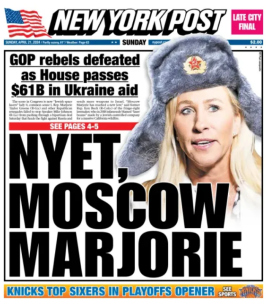
Credit – The New York Post
Is Russian Disinformation Increasing Opposition to Support of Ukraine
On April 8, The Washington Post published an investigation into an extensive and coordinated Russian campaign to influence U.S. public opinion to deny Ukraine the aid, including reporting on documents showing Russian government involvement. The article described the Russian disinformation effort as follows:
“In an ongoing campaign that seeks to influence congressional and other political debates to stoke anti-Ukraine sentiment, Kremlin-linked political strategists and trolls have written thousands of fabricated news articles, social media posts and comments that promote American isolationism, stir fear over the United States’ border security and attempt to amplify U.S. economic and racial tensions.”
Such efforts may have an impact on American public opinion, as increasing numbers believe the U.S. is providing too much aid to Ukraine. Some Republican lawmakers also believe Russian disinformation is affecting the American public. House Foreign Affairs Committee head Michael McCaul said, “Russian propaganda has made its way into the U.S., unfortunately, and it’s infected a good chunk of my party’s base.” Rep. Michael R. Turner of Ohio said on CNN’s “State of the Union”, “We see directly coming from Russia attempts to mask communications that are anti-Ukraine and pro-Russia messages — some of which we even hear being uttered on the House floor.”
Just a few days ago, CNN reported that hard right Representative Marjorie Taylor Greene of Georgia “suggested US military funding would go to “Ukrainian Nazis” on her X account, repeating “a false claim about Ukraine pushed by Putin.” Another Republican lawmaker, retiring Representative Ken Buck of Colorado was more blunt, “She [Greene] is just mouthing the Russian propaganda, and really hurting American foreign policy in the process.” Buck has referred to Greene as “Moscow Marjorie”, a phrase that was picked up by The New York Post on its cover page along with a matching image (see photo above). Conservative media more generally seems to be piling on, even calling Greene an “idiot”.
The Case for Supporting Ukraine
Just as a refresher, Ukraine was one of the republics which made up the Soviet Union. After the Soviet Union disbanded, Ukraine became an independent nation, a status that was agreed upon by Russia and the United States. Russia continued to have influence, though Ukraine seemed to be drifting closer to the U.S. and the rest of Europe right up until Russia’s commencement of a military campaign in the Ukrainian Crimea region in 2014. However we got to that point, the US and Ukrainian alliance became the reality, with Ukrainian freedom from Russian influence as a key driver.
Although not meaning to have Ukraine be another square in a “cold war chessboard” battle between the US and Russia, that has seemed to be the case. In a sense, Ukraine is one part of the broader global battle for the US against its greatest challengers and enemies, Russia and Communist China. Russia has continued to seek influence in places like Syria and more recently in African countries like Niger, which has led to the overthrow of US-friendly democratic government there. And though Russia is no longer communist, it features an authoritarian government much like China’s, with Putin in charge. Clearly, Putin does not seem to be a friend of democracy, as shown by his attempts and apparent success in orchestrating the murder of political foes like Alexei Navalny.
The concerns of Ukraine falling to Russia mainly revolve around a sort of old-school, anti-Communist domino theory in which Russia will not stop with Ukraine. Next on the horizon might be NATO members like Poland, and a possible escalation to a larger European war with US troops involved. In the interim, the failure of the US to support an ally and a young democracy in Ukraine could make it appear as a sign of weakness, giving hesitation to other allies the US has pledged to support and the “green light” to Russia to expand its influence and China to do the same, for example with Taiwan. As the world is even more globally connected today than it was 80 to 100 years ago in the lead-up to World War II, a reversion to isolationism seems imprudent. Moreover, America’s ability to pull back from being the leading global superpower without a clear view of the resulting new world order, an order which ideally would not negatively affect us nor our allies, might be difficult. In other words, we are stuck with it.
Democracy Wins Twice, Russian Disinformation Loses
Domestically, Russian disinformation efforts were unable to stop the majority support of the American people nor the supermajority of Congress from providing aid to Ukraine. Democracies in Europe and Ukraine won as well, empowered to fight for self-rule without conceding to a militarily threatening neighbor.
Make no mistake, disinformation campaigns by Russia and/or China can be powerful in shifting opinions of both the public and government representatives. The failsafe against such incursions continues to be a strong democracy. As a system of government, democracy may not be as efficient as a simple dictatorship. But as the old saying often attributed to Winston Churchill goes, “Americans will always do the right thing, only after they have tried everything else.”